Duck & Goose Calls Guide
Are Electronic Duck and Goose Calls Legal?
Federal law bars recorded or electrically amplified calls for migratory birds, with two narrow, quoted exceptions. Here's what the rule actually says.
We may earn a commission when you buy through links on this page, at no extra cost to you. It never decides the ranking: the scoring method is published. How we're funded
The federal rule on electronic calls
50 CFR 20.21 lists illegal methods for taking migratory game birds. Paragraph (g) is the electronic-call rule, and it does not distinguish between ducks, Canada geese or any other migratory bird: recorded and electrically amplified calls, or imitations of them, are prohibited outright. There is no general exception for hunting on private land, for a particular state, or for any species outside the two carve-outs below.
The two exceptions, quoted
Per the same paragraph, the prohibition "does not apply during":
- "A light-goose-only season (greater and lesser snow geese and Ross' geese) when all other waterfowl and crane hunting seasons, excluding falconry, are closed."
- "A hunting season only for Canada and cackling geese during the period of September 1 to September 30, provided: (i) The season occurs within the Atlantic, Central, and Mississippi Flyways"; (ii) "All other waterfowl and crane hunting seasons, excluding falconry, are closed"; and (iii) "The State notifies the Service's Migratory Bird Program by May 31 each year of its intention to authorize the additional hunting method."
Read that closely: exception 1 is species-specific (light geese only) and requires every other waterfowl and crane season to be closed. Exception 2 is a narrow, state-opted-in September window for Canada and cackling geese, limited to three flyways, that also requires every other season closed and a state notification on file with USFWS. Outside those two windows, an electronic or recorded call is not a legal method for ducks, geese, or any other migratory game bird, in any state.
The Light Goose Conservation Order
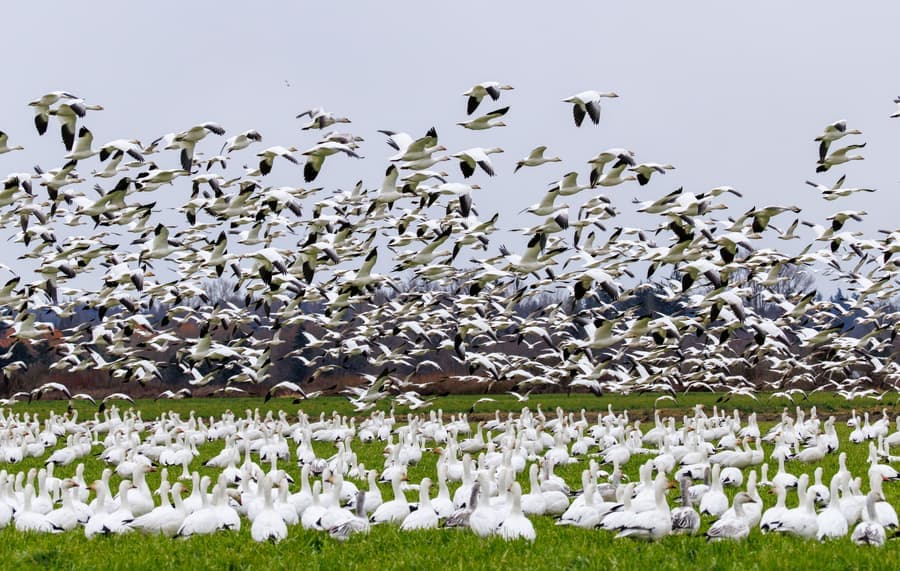
The light-goose-only season named in exception 1 is most commonly run as the spring Light Goose Conservation Order, authorized under a separate rule, 50 CFR 21.180. That rule defines "light geese" as greater snow, lesser snow and Ross's geese collectively, and describes the conservation order as a special management action authorized under the Migratory Bird Treaty Act to reduce overabundant light goose populations. Where authorized, it allows new methods of taking light geese, extends shooting hours to one-half hour after sunset, and removes daily bag limits for light geese. The Director can authorize it across parts of the Atlantic, Mississippi, Central and Pacific Flyways, but only in specific states and specific years, based on population data. It is not a standing, everywhere, every-year season, and it does not run during your state's regular waterfowl seasons.
None of this is a substitute for your state's own regulations page. States can be, and often are, stricter than the federal floor. Check your state wildlife agency's current conservation-order dates and rules, and the waterfowl hunting season guide for how federal frameworks and state seasons fit together, before you plan a spring hunt around spring snow goose gear.
How and when it gets authorized
The conservation order isn't automatic. Per 50 CFR 21.180, the Director authorizes it flyway by flyway, based on population data, and publishes a notice in the Federal Register when it applies: for the Atlantic Flyway, when the May Waterfowl Population Status report shows greater snow geese have exceeded a management goal of 500,000 birds and conservation actions in Canada aren't enough to reduce the population; for the Mississippi and Central Flyways, when the report shows mid-continent light geese (lesser snow and Ross's) have exceeded a combined winter-index goal of 1,600,000 birds; and for the Pacific Flyway, when the Director determines light goose numbers in the western Arctic have exceeded what their breeding habitat can support. It can be in effect for one light goose population and not another at the same time.
The rules once it's authorized
The conservation order changes more than just the electronic-call rule. Per the same section, where it's authorized, participants may not sell light geese or their plumage; must permit federal or state game wardens free access to check their activities; and are barred from taking light geese with a trap, snare, net, rifle, pistol, a shotgun larger than 10 gauge, a sinkbox or similar low floating blind, a motor vehicle or aircraft (with a narrow exception for hunters with mobility impairments), live decoys, or by baiting. Shot is limited to nontoxic types authorized under 50 CFR 20.21(j), the same nontoxic-shot rule that applies to waterfowl generally. None of this authorizes taking light geese against your own state's laws; the rule is explicit that state or tribal permits and restrictions still apply on top of it.
Spinning-wing and motorized decoys sit under the same state-by-state patchwork as electronic calls, and several states restrict them outright or by date. If you are shopping for one, MOJO vs Lucky Duck compares the two main brands on published specs and repeats the same warning: check your own state's current regulations first.
E-callers, only in that context
The two electronic callers below are marketed by their makers specifically for snow goose hunting during a light-goose-only season. Neither is legal for ducks or for a regular Canada goose season; both carry that exact caution from us. Confirm the conservation order is authorized and running in your state, with all other waterfowl and crane seasons closed, before you use one.
If you have confirmed that and you are choosing between units, the full ranking is at best electronic snow goose callers, which compares these two against a third snow-goose-specific caller on published sound libraries, speaker wattage, remote range, run time and the one unit here with a published weatherproofing rating.
How we picked
Why these made the list
Every pick here is researched and compared against the maker's published specs, manuals and warranty terms, scored on a rubric we publish, with each source linked at the bottom of the page.
The weights below are the ones each score was actually computed with, and they hold on every page a product appears on, so the order you see is the order the numbers give. Nobody pays for placement. See every rubric and weight.
Field accessories rubric
- Function & features
- 30%
- Build & materials
- 25%
- Weather resistance
- 20%
- Size & portability
- 10%
- Warranty
- 15%
FAQ
Questions hunters ask
Are electronic duck calls legal?
When can you use an electronic goose call?
What is the Light Goose Conservation Order?
Can I use an electronic caller for snow geese any time of year?
What triggers the Light Goose Conservation Order?
Can you sell geese taken under the conservation order?
Do states have their own rules on electronic calls?
Related
Keep reading
Update log
What changed
- First published.
Receipts
Sources
- 1.eCFR: 50 CFR 20.21, Illegal Hunting Methods, paragraph (g) (accessed Sep 19, 2026)
- 2.eCFR: 50 CFR 21.180, Conservation order for light geese (accessed Sep 19, 2026)
- 3.U.S. Fish & Wildlife Service: Migratory Birds Program (accessed Sep 19, 2026)
- 4.FOXPRO: Snow Pro product page and spec table (checked Sep 19, 2026)
- 5.Lucky Duck: White Devil E-Caller product page (checked Sep 19, 2026)
Specs, materials and warranty terms come from the maker's own pages and manuals (or a named retailer's listing where the maker doesn't publish them), and every one is linked above. Regulations are linked to the agency that writes them. Prices are set by Amazon and change often, so the current number lives on the buy button rather than in the copy. Read the full method.