Kits by Season & Flyway Kit
Spring Snow Goose Gear
The light goose conservation order isn't a hunting season in the usual sense, it's a population-control measure with its own rules, including the one exception on this entire site where electronic calls are legal.
We may earn a commission when you buy through links on this page, at no extra cost to you. It never decides the ranking: the scoring method is published. How we're funded
What the conservation order actually is
Per 50 CFR 21.180, the order covers "greater snow (Anser caerulescens atlantica), lesser snow (A. c. caerulescens), and Ross's (C. rossii) geese," collectively "light geese." The regulation is explicit that this is not a normal hunting season: it authorizes "control activities" conducted "clearly as such" under the Migratory Bird Treaty Act, timed to run only when "all waterfowl...and crane hunting seasons...are closed." Within that window, the rule "imposes no daily bag limits for light geese inside or outside the migratory bird hunting season frameworks" and allows "shooting hours for light geese to end one-half hour after sunset," both changes from the regular-season rules described in the season guide. This page does not state actual dates; the order's authorized window and any state-specific details come only from your state wildlife agency and the sources linked throughout.
Why it exists
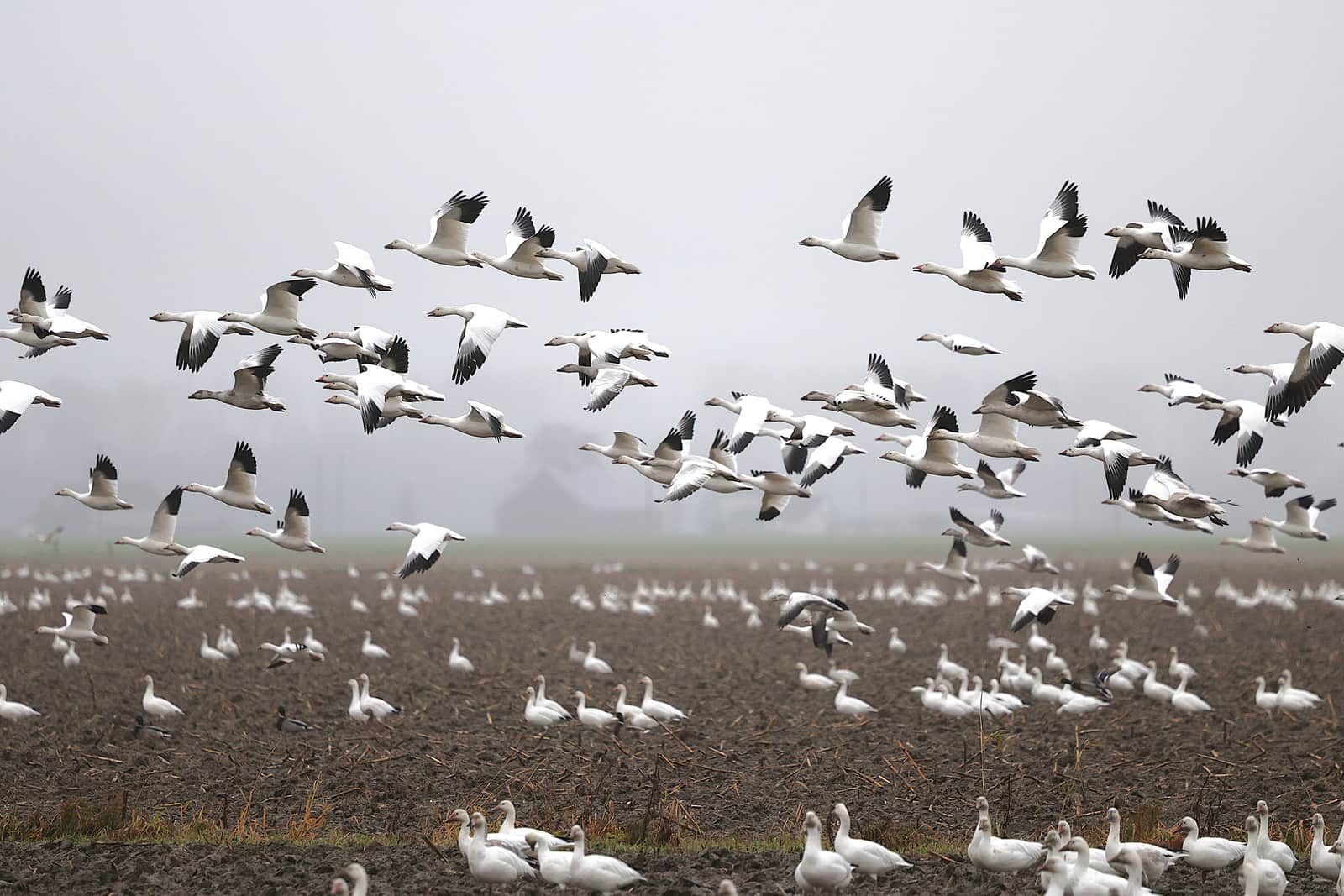
The order exists because the birds it targets became a genuine habitat problem. Per the U.S. Fish and Wildlife Service, decades of abundant agricultural food along migration routes caused light goose numbers to grow sharply, and "large areas of the breeding grounds around Hudson Bay have been denuded of all vegetation by geese through overgrazing." The Service created "special hunting provisions to reduce light goose numbers" specifically to slow that "widening destruction of fragile arctic migratory bird breeding habitat," which is also why the order authorizes normally prohibited methods, electronic calls among them, that make harvesting large numbers of birds more practical. The order can be authorized by flyway; see the U.S. Fish and Wildlife Service's administrative flyways overview for how the Atlantic, Mississippi, Central and Pacific flyways are organized, and check your state agency for whether the order is authorized in your state this year.
Big spreads
Because the order exists to increase harvest of an overabundant population, spreads built around it run much larger than a regular-season goose spread, often hundreds of decoys rather than a few dozen. See how many goose decoys you need for how spread size scales by season and species, and best goose decoys for the full lineup this kit draws from. A practical big spread mixes full bodies close to the blind, where detail shows, with lighter socks and shells to bulk out the rest at a weight and cost per bird that hundreds of full bodies can't match.
Electronic callers, legally
Per 50 CFR 20.21(g), taking migratory birds "by the use or aid of recorded or electrically amplified bird calls or sounds" is prohibited nationwide, with two narrow exceptions: a light-goose-only season with every other waterfowl and crane season closed, and a separate September 1-30 exception for early Canada and cackling goose seasons in specific flyways. The light goose conservation order is the first of those exceptions, which is why electronic callers are legal gear here and nowhere else this site covers. See electronic caller laws for the full exception language and how it applies outside this kit; outside the conditions described there, electronic calls remain illegal for migratory birds.
Layout blinds for open fields
Snow geese work open fields in huge, wary flocks, and by spring the stubble and cover that hid a blind in the fall is often thinner, wetter or gone entirely. See best layout blinds for the full lineup; these two sit at opposite ends of it, one built to disappear into short cover and one built to handle standing water and mud.
Layering for a spring hunt
A conservation-order hunt runs in a very different temperature band than the late-season kit above: cold mornings are still common, but the deep, standing-water freeze that drives late-season gear toward the warmest waders on the site is usually gone by the time light geese are moving through in numbers. Most conservation-order hunters are working dry or thawing fields rather than standing in open water for hours, which shifts the priority toward a windproof, waterproof outer layer over deep insulation. See what to wear duck hunting for the base-to-shell layering system, and neoprene vs. breathable waders if your spread is set up over standing water rather than a dry field.
Check your state
This page does not state a season date, a bag limit or a shooting hour beyond what 50 CFR 21.180 itself specifies (no daily bag limit on light geese, shooting hours extended to one-half hour after sunset). Whether the conservation order is authorized in your state this year, and any state-specific permit or registration requirements, come only from your state wildlife agency.
Situation notes: weight, storage and cost per bird
The three decoy types above trade off in predictable ways once a spread scales past a few dozen birds. Full bodies, like the Dakota Migration Series above, deliver the most realism and detail at the shortest range, which is why hunters put them closest to the blind, but they take the most truck and storage space per bird. Socks, like Dakota's Snap Lock system, are the lightest and most compact per decoy by a wide margin, which is how conservation-order hunters realistically get to spread sizes in the hundreds without hundreds of full bodies to haul. Shells sit in between: GHG's Pro-Grade shells stack for storage and publish more body than a sock, without the weight and bulk of a full spread of full bodies. Most working spreads mix all three rather than running one type exclusively, full bodies up close, socks and shells filling out the rest.
The same logic applies to the electronic callers above: the corded FOXPRO unit spreads sound across a large area through up to four speakers but means running cords through the spread, while the wireless Lucky Duck system trades that cord-running for two independently placed speakers. Neither is a wrong choice; it's a question of how you'd rather manage the physical setup of a large spread.
Who should skip this kit
Skip this kit if you're hunting Canada geese in a regular season rather than light geese under the conservation order; the spread sizes, the electronic callers and the no-bag-limit framing here don't apply, and best goose decoys or the flyway kit that matches your water is the right starting point instead. Skip it too if the conservation order isn't authorized in your state or flyway this year; outside of it, the electronic-caller exception described above does not apply, and running one is illegal under 50 CFR 20.21. Confirm authorization with your state wildlife agency before you plan a hunt, let alone buy gear, around it.
How we picked
Scored on paper, and we say so
Most gear sites say they tested everything. We didn't test these, and we say so. Every pick is scored from the maker's published specs, manuals and warranty terms on a rubric we publish, and the sources are listed at the bottom of the page.
Scores are editorial judgments from that published information, not field or lab results. Nobody pays for placement, and an unpublished spec is never guessed upward. See every rubric and weight.
Duck & goose decoys rubric
- Realism features
- 25%
- Durability & construction
- 25%
- Rigging & motion options
- 15%
- Packability & weight
- 20%
- Warranty & parts
- 15%
Field accessories rubric
- Function & features
- 30%
- Build & materials
- 25%
- Weather resistance
- 20%
- Size & portability
- 10%
- Warranty
- 15%
Layout & A-frame blinds rubric
- Concealment features
- 30%
- Comfort
- 20%
- Weight & portability
- 20%
- Door & visibility design
- 15%
- Warranty
- 15%
FAQ
Questions hunters ask
How many snow goose decoys do I need?
Are electronic calls legal for snow goose hunting?
What is the light goose conservation order?
Is a snow goose spread different from a regular Canada goose spread?
Do you need a special permit for the conservation order?
Related
Keep reading
- Electronic caller lawsThe full exception language, quoted.
- Best goose decoysThe full lineup this kit's picks are drawn from.
- How many goose decoys you needSpread size by season and species.
- Best layout blindsThe full lineup for open-field concealment.
- Waterfowl hunting season guideHow the conservation order fits outside the regular season.
Update log
What changed
- First published.
Receipts
Sources
- 1.Cornell Law School Legal Information Institute: 50 CFR 20.21 (accessed Sep 19, 2026)
- 2.Cornell Law School Legal Information Institute: 50 CFR 21.180, Conservation order for light geese (accessed Sep 19, 2026)
- 3.U.S. Fish and Wildlife Service: President Signs Snow Goose Bill to Protect Arctic Habitat (accessed Sep 19, 2026)
- 4.U.S. Fish and Wildlife Service: Migratory Bird Program Administrative Flyways (accessed Sep 19, 2026)
We don't field-test decoys, calls, waders or blinds, and we don't pretend to. Specs, materials and warranty terms come from the maker's own pages and manuals (or a named retailer's listing where the maker doesn't publish them). Regulations are linked to the agency that writes them. Prices are set by Amazon and change often, so we don't print them. Where a figure isn't published, we say so. Read the full method.