Waders & Cold-Weather Layering Comparison
LaCrosse vs Muck Boots for Duck Hunting
Two insulation philosophies in the same boot: LaCrosse builds a lined rubber boot with a Thinsulate rating, Muck builds a neoprene bootie in millimeters. The published numbers say when each one wins.
We may earn a commission when you buy through links on this page, at no extra cost to you. It never decides the ranking: the scoring method is published. How we're funded
Side by side
The picks on each side
Muck, warmest
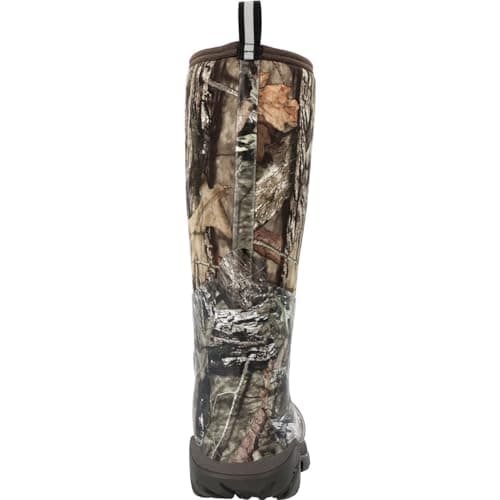
Muck Boot Men's Arctic Pro Insulated Boot
7.8 / 10An 8mm neoprene bootie with a fleece lining and 2mm thermal foam under the footbed, 17 inches tall, published with a comfort range of -60F to 30F. The heaviest boot here at about 2.50 lbs per boot in a size 10.
Check price on Amazon#ad · Price set by Amazon · Affiliate disclosure for the link to Muck Boot Men's Arctic Pro Insulated Boot
LaCrosse, warmest
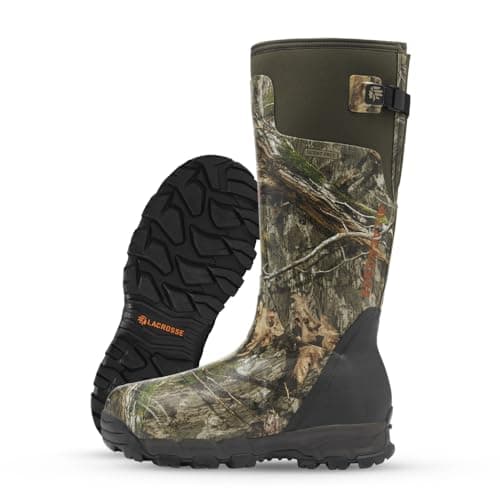
LaCrosse Alphaburly Pro 18" 1000G
7.3 / 1018 inches of scent-free rubber over 1000G Thinsulate Ultra with a published comfort zone of -60F to 30F, an adjustable neoprene gusset at the calf and a nylon shank. 5.5 lbs per pair, which is the lightest warm boot here.
$239.95Amazon#ad · Price as of November 2, 2026 · Affiliate disclosure for the link to LaCrosse Alphaburly Pro 18" 1000G
Muck, all-season
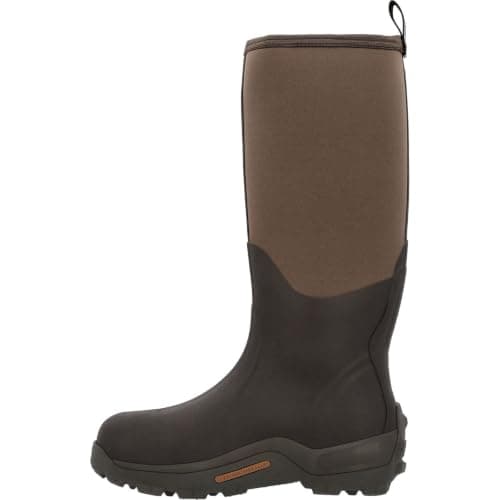
Muck Boot Men's Wetland Boot
7.3 / 10The 5mm neoprene classic at 18 inches with a breathable air-mesh lining, a calf-high rubber overlay, an MS-1 molded outsole and a stretch-fit topline. About 2.75 lbs per boot in a size 10 and no published temperature range.
$144.99Amazon#ad · Price as of November 2, 2026 · Affiliate disclosure for the link to Muck Boot Men's Wetland Boot
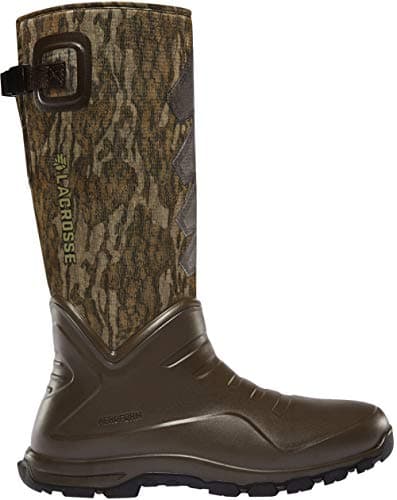
LaCrosse, most abrasion-resistant
LaCrosse AeroHead Sport 16" 7.0MM
7.2 / 10A polyurethane AeroForm shell over insulated 7mm neoprene with Brush Tuff material, an abrasion-resistant shin guard and a non-loading Aero Sport outsole, at 16 inches and 5 lbs per pair - the lightest boot on this page.
$79.99Amazon#ad · Price as of November 2, 2026 · Affiliate disclosure for the link to LaCrosse AeroHead Sport 16" 7.0MM
The short version
These two brands dominate the rubber boot aisle and they are solving the same problem in genuinely different ways, which makes the comparison worth more than a brand preference. Muck builds a neoprene bootie and wraps it in rubber. LaCrosse builds a rubber boot and lines it with Thinsulate. Everything else — weight, flex, abrasion resistance, how the boot handles a long walk — follows from that one decision.
A note on scope: both brands sell far wider lines than any site can rank, and this page compares the four boots in our registry that are currently sold and have specs published by the maker. The reasoning below applies to the rest of either line — check the insulation format, the published temperature range, the weight and the outsole before you buy.
Two ways to insulate a rubber boot
Muck publishes insulation in millimeters of neoprene. The Arctic Pro is an 8mm bootie with a fleece lining and 2mm of thermal foam under the footbed; the Wetland is 5mm with a breathable air-mesh lining. Neoprene insulates by trapping air in closed cells, and because it is a stretchy foam it flexes with the foot and seals around the ankle and calf. That is why a Muck boot feels different the moment you put it on — the insulation is the boot, not a liner inside it.
LaCrosse publishes insulation in grams of Thinsulate or millimeters of neoprene depending on the model. The Alphaburly Pro 18" carries 1000G Thinsulate Ultra inside waterproof, scent-free rubber with a polyester jersey lining; the AeroHead Sport runs insulated 7mm neoprene inside a polyurethane AeroForm shell. Thinsulate is a loft insulation: it works by thickness and air, so it is warm without being stiff, and it can be paired with a thinner, lighter outer shell.
Both of the warm boots here publish the same figure: a comfort range of -60°F to 30°F for the Muck Arctic Pro and a comfort zone of -60°F to 30°F for the LaCrosse Alphaburly Pro 1000G. Treat those as the makers' own claims rather than lab standards, and treat the upper number as the useful one — both boots are too warm for a September teal hunt, which is where the thinner Wetland and AeroHead belong. The site-wide ranking across all brands is in best duck hunting boots.
One thing neither brand can fix with insulation: wet socks. Sweat is the main reason feet get cold in a rubber boot, and a merino or synthetic sock does more for warmth than 300 grams of anything — see best socks for duck hunting and how to stay warm duck hunting.
Weight, height and the walk in
This is where the two brands separate most clearly, and it is the spec most people ignore until the third mile.
Muck publishes average weights per boot: about 2.50 pounds for the Arctic Pro and about 2.75 pounds for the Wetland in a size 10, which works out to roughly 5 to 5.5 pounds a pair. LaCrosse publishes per-pair weights directly: 5.5 pounds for the Alphaburly Pro 18" 1000G and 5 pounds for the AeroHead Sport 16". So the warmest boots from both brands land in the same place, and the lightest boot on the page is the LaCrosse AeroHead Sport, which gets there with a polyurethane shell rather than a rubber one.
Height differs in a way that matters for shallow water. The Muck Wetland is 18 inches, the Arctic Pro is 17, the Alphaburly Pro is 18 and the AeroHead Sport is 16. Two inches sounds trivial until you are standing in a flooded ditch; 16 inches is a dry-field and shallow-marsh boot, 18 inches is the practical maximum for a knee boot before you should simply be in hip boots or waders — which is the argument in waders vs hip boots and best hip boots for duck hunting.
LaCrosse also publishes a fit feature neither Muck boot has: an adjustable neoprene gusset on the Alphaburly Pro that cinches the calf. If you have thin calves and have had boots suck off in mud, that is the spec you are looking for.
Outsoles and mud
An outsole in waterfowl country has one job that road boots never face: shedding mud instead of packing it. A tread that loads up turns into a smooth platform in a hundred yards, which is both exhausting and genuinely dangerous on a levee.
LaCrosse publishes the clearest claim here: the AeroHead Sport uses an Aero Sport outsole described as non-loading, and the Alphaburly Pro uses a Burly Pro outsole over a nylon shank. A shank matters as much as the tread — it is what keeps the boot from folding when you pull a foot out of suction mud.
Muck publishes a Bob-Tracker multi-terrain outsole with an EVA midsole on the Arctic Pro and an MS-1 molded outsole with a lightweight EVA midsole on the Wetland. EVA midsoles are the reason Muck boots walk softer on hard ground than a plain rubber boot does.
Both brands publish a 1-year limited warranty: Muck a 1-year limited warranty, LaCrosse one year from the date of original purchase. Neither covers punctures or abrasion, which in a rubber boot means the usual killer — a stob through the instep — is on you. Treat a rubber boot as a two-to-four-season item regardless of brand.
Which to buy
Buy the Muck Arctic Pro if you sit still in the cold: field blinds, pit blinds, late-season mornings with no walking. The 8mm bootie, fleece lining and footbed foam are built for a boot that is not generating any heat of its own, and the neoprene flexes rather than fighting your foot.
Buy the LaCrosse Alphaburly Pro 18" 1000G if you need one boot for everything: the same published comfort range as the Arctic Pro, 18 inches of height, 5.5 pounds a pair, a nylon shank and a calf gusset you can cinch. It is the most versatile boot on this page.
Buy the Muck Wetland if your season is mild to moderate and you want the classic: 5mm neoprene, air-mesh lining, 18 inches. Buy the LaCrosse AeroHead Sport if the walk is long or the cover is nasty — 5 pounds a pair, a polyurethane shell, Brush Tuff material and a shin guard built for briars.
Whichever you buy, size it with socks on and read best duck hunting boots for where these four land against the rest of the field. If you are regularly going deeper than your boot top, the real answer is a wader — see best duck hunting waders and do you need waders.
In detail
Every contender, in full
Muck, warmest
Muck Boot Men's Arctic Pro Insulated Boot
Scored on the jackets, gloves, boots & layers rubric
An 8mm neoprene bootie with a fleece lining and 2mm thermal foam under the footbed, 17 inches tall, published with a comfort range of -60F to 30F. The heaviest boot here at about 2.50 lbs per boot in a size 10.
Published specs (tap for source)
- Waterproof & windproof spec (25%)
- 8
- Insulation spec (25%)
- 9
- Waterfowl-specific features (20%)
- 7.5
- Dexterity & fit range (15%)
- 7.5
- Warranty (15%)
- 6
What it gets right
- 8mm neoprene bootie, the thickest boot neoprene in this group
- Published comfort range down to -60°F
- Steel-toe option
What it doesn't
- 17-inch height, an inch shorter than the Wetland
- 1-year limited warranty
Skip it if…
…you mostly hunt early teal season; Muck's published comfort range for the Arctic Pro tops out at 30°F.
#ad · Price set by Amazon · Affiliate disclosure for the link to Muck Boot Men's Arctic Pro Insulated Boot
LaCrosse, warmest
LaCrosse Alphaburly Pro 18" 1000G
Scored on the jackets, gloves, boots & layers rubric
18 inches of scent-free rubber over 1000G Thinsulate Ultra with a published comfort zone of -60F to 30F, an adjustable neoprene gusset at the calf and a nylon shank. 5.5 lbs per pair, which is the lightest warm boot here.
Published specs (tap for source)
- Waterproof & windproof spec (25%)
- 8
- Insulation spec (25%)
- 8
- Waterfowl-specific features (20%)
- 8
- Dexterity & fit range (15%)
- 5
- Warranty (15%)
- 6
What it gets right
- Published comfort zone down to -60°F
- Adjustable neoprene gusset for different calf sizes
- 18-inch height
What it doesn't
- 1-year warranty
- Size range is not listed on the spec source page
Skip it if…
…you walk long distances to your spot and want LaCrosse's lighter option; the AeroHead Sport is published at 5 lbs per pair to this boot's 5.5 lbs.
#ad · Price as of November 2, 2026 · Affiliate disclosure for the link to LaCrosse Alphaburly Pro 18" 1000G
Muck, all-season
Muck Boot Men's Wetland Boot
Scored on the jackets, gloves, boots & layers rubric
The 5mm neoprene classic at 18 inches with a breathable air-mesh lining, a calf-high rubber overlay, an MS-1 molded outsole and a stretch-fit topline. About 2.75 lbs per boot in a size 10 and no published temperature range.
Published specs (tap for source)
- Waterproof & windproof spec (25%)
- 8
- Insulation spec (25%)
- 6.5
- Waterfowl-specific features (20%)
- 8
- Dexterity & fit range (15%)
- 7.5
- Warranty (15%)
- 6
What it gets right
- 18-inch height
- Stretch-fit topline binding snugs the calf
- Sizes 5 through 15
What it doesn't
- No comfort rating or gram-rated insulation published
- Mesh lining rather than fleece
- 1-year limited warranty
Skip it if…
…you sit in sub-freezing blinds; Muck publishes no cold rating for the Wetland, while its Arctic Pro is rated to -60°F.
#ad · Price as of November 2, 2026 · Affiliate disclosure for the link to Muck Boot Men's Wetland Boot
LaCrosse, most abrasion-resistant
LaCrosse AeroHead Sport 16" 7.0MM
Scored on the jackets, gloves, boots & layers rubric
A polyurethane AeroForm shell over insulated 7mm neoprene with Brush Tuff material, an abrasion-resistant shin guard and a non-loading Aero Sport outsole, at 16 inches and 5 lbs per pair - the lightest boot on this page.
Published specs (tap for source)
- Waterproof & windproof spec (25%)
- 7.5
- Insulation spec (25%)
- 7
- Waterfowl-specific features (20%)
- 8
- Dexterity & fit range (15%)
- 7
- Warranty (15%)
- 6
What it gets right
- Lighter published weight than the Alphaburly Pro (5 vs 5.5 lbs per pair)
- Shin guard and Brush Tuff upper for briers
- LaCrosse says the neoprene upper can be rolled down when it warms up
What it doesn't
- No gram-rated insulation; warmth comes from 7mm neoprene
- No comfort rating published
- 1-year warranty
Skip it if…
…you sit still in freezing water for hours and want a gram-rated boot with a published comfort range.
#ad · Price as of November 2, 2026 · Affiliate disclosure for the link to LaCrosse AeroHead Sport 16" 7.0MM
How we picked
Why these made the list
Every pick here is researched and compared against the maker's published specs, manuals and warranty terms, scored on a rubric we publish, with each source linked at the bottom of the page.
The weights below are the ones each score was actually computed with, and they hold on every page a product appears on, so the order you see is the order the numbers give. Nobody pays for placement. See every rubric and weight.
Jackets, gloves, boots & layers rubric
- Waterproof & windproof spec
- 25%
- Insulation spec
- 25%
- Waterfowl-specific features
- 20%
- Dexterity & fit range
- 15%
- Warranty
- 15%
FAQ
Questions hunters ask
Are LaCrosse or Muck boots better for duck hunting?
Which is warmer, 1000g Thinsulate or 8mm neoprene?
How tall should a duck hunting boot be?
Do LaCrosse and Muck boots have a warranty?
Why do my feet still get cold in insulated boots?
Related
Keep reading
- Best duck hunting bootsBoth brands against the whole field.
- Best hip boots for duck huntingWhen 18 inches is not enough.
- Waders vs hip bootsWhere a knee boot stops making sense.
- Best socks for duck huntingThe part that actually keeps feet warm.
- How to stay warm duck huntingHands and feet, in order of what works.
Update log
What changed
- First published.
Receipts
Sources
- 1.The Original Muck Boot Company: Men's Arctic Pro Insulated Boot product page (checked Sep 19, 2026)
- 2.The Original Muck Boot Company: Men's Wetland Boot product page (checked Sep 19, 2026)
- 3.Scheels (retailer): Men's LaCrosse Alphaburly Pro 18" 1000G Boots product page (checked Sep 19, 2026)
- 4.LaCrosse Footwear: AeroHead Sport 16" Realtree Edge 7.0MM product page (checked Sep 19, 2026)
- 5.LaCrosse Footwear support: What is the warranty period for my boots? (checked Sep 19, 2026)
Specs, materials and warranty terms come from the maker's own pages and manuals (or a named retailer's listing where the maker doesn't publish them), and every one is linked above. Regulations are linked to the agency that writes them. Prices are set by Amazon and change often, so the current number lives on the buy button rather than in the copy. Read the full method.