Decoys & Spreads Comparison
Spinning-Wing Decoy vs Jerk Rig: Which Motion to Run
A spinner is visible from a long way off and illegal in places. A jerk rig never needs a battery and never flares a wary duck. Here is what the spec sheets say, and which one earns its spot first.

We may earn a commission when you buy through links on this page, at no extra cost to you. It never decides the ranking: the scoring method is published. How we're funded
Side by side
The picks on each side
Pick a spinner for long-range visibility
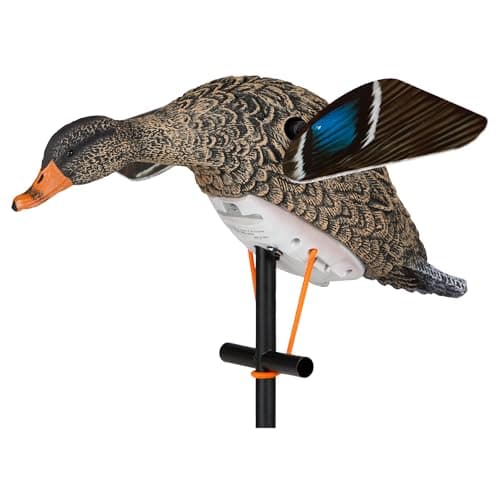
Lucky Duck Lucky HD
6.7 / 10Injection-molded magnetic wings on a 3-piece 42-inch stake with a published 18-plus hour runtime on an included 6V battery and charger. The most capable spinner here, and the one most likely to be the thing a late-season mallard notices and avoids.
$149.99Amazon#ad · Price as of November 4, 2026 · Affiliate disclosure for the link to Lucky Duck Lucky HD
Pick a spinner if you walk in
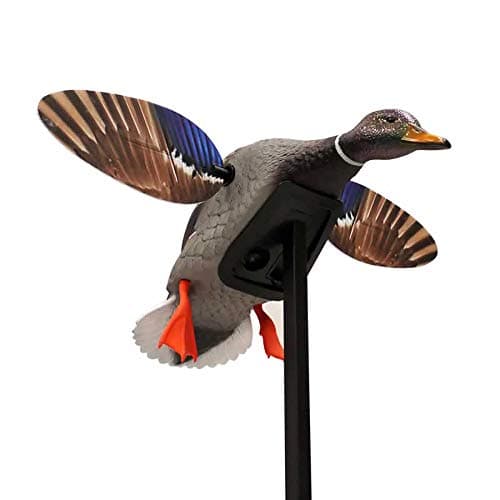
MOJO Elite Series Mini Mallard Drake
5.5 / 10A compact MOJO on four AA batteries with the motor and wings mounted directly to the support pole and a housing that comes out of the body. No published runtime, which is the trade for the small pack size.
$89.22Amazon#ad · Price as of November 4, 2026 · Affiliate disclosure for the link to MOJO Elite Series Mini Mallard Drake
Pick a jerk rig for the easiest setup
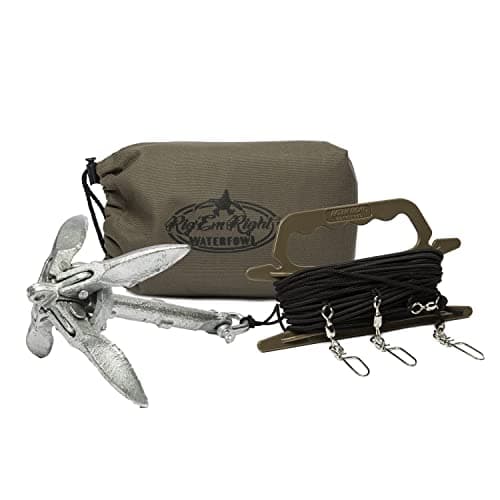
Rig'Em Right Jerk Rig
6.6 / 10100 feet of nylon line with pre-tied swivels for four decoys, a 1.5-lb folding anchor, bungee, winder and stuff sack. Rig'Em Right recommends it for water up to 5 feet and publishes a 1-year limited warranty.
$39.99Amazon#ad · Price as of November 4, 2026 · Affiliate disclosure for the link to Rig'Em Right Jerk Rig
- Higdon OutdoorsNo image
Pick a jerk rig to move the most decoys
Higdon Outdoors Battleship Jerk Rig
6.8 / 10125 feet of PVC-coated steel cable and six quick-connect clips, so it works half again as many decoys as the four-decoy rigs. Higdon lists a 30-day return policy and no longer warranty term.
Not sold on Amazon
Amazon doesn't sell it and we have no tracked retailer that does, so there is no buy link here. The specs above come from Higdon Outdoors's own published page.
What each one actually does
These two products get shelved together as "motion" and sold to the same hunter, but they solve opposite problems and they are not substitutes for one another.
A spinning-wing decoy is an advertisement. The whole mechanism is a pair of wings spinning on a pole fast enough that the alternating dark and light surfaces read, at distance, as a duck landing. It is a long-range attractor: its job is finished before the birds are anywhere near your spread. The Lucky Duck Lucky HD runs injection-molded magnetic wings on a three-piece 42-inch stake; the MOJO Elite Series Mini Mallard mounts the motor and wings directly to the support pole with a housing that pulls out of the decoy body. Neither moves water. Neither makes a ripple. They flash.
A jerk rig is a close-range convincer. You pull a line and four to six floaters swim, bob and push water. That is the detail a duck circling at thirty yards is looking for, because a spread of perfectly still decoys on a glassy pothole looks exactly as dead as it is. The Rig'Em Right Jerk Rig gives motion to up to four decoys on 100 feet of nylon line with pre-tied swivels; Higdon's Battleship Jerk Rig runs 125 feet of PVC-coated steel cable with six quick-connect clips and produces swimming, feeding and bobbing motion with no batteries or wires. The trade is that you have to be holding the line, and you have to remember to pull it.
Put plainly: the spinner gets birds to turn, the jerk rig gets them to commit. If you only own one, you want the one that works on the birds that have already found you, because the ones that never see your spread were probably never going to.
Both families are ranked in full at best motion decoys, and the jerk-rig field on its own at best jerk rigs.
Side by side
Two spinners against two jerk rigs, exactly as the makers publish them. The empty cells are the finding: a jerk rig publishes no runtime because it has none to publish, and one of the two spinners publishes no runtime at all.
Three things jump out of that table. First, the runtime gap: Lucky Duck publishes 18-plus hours on an included 6V battery with a smart charger and an external charging port, while MOJO publishes no runtime figure for a decoy that runs on four AA batteries you supply. If you hunt all-day sits, that difference is the purchase. Second, the decoy-count difference between the jerk rigs is real and under-appreciated: four decoys versus six is the difference between a visible pocket of movement and a nudge. Third, the warranty column splits in an unexpected direction — the cheapest category here, jerk rigs, carries the better published term from Rig'Em Right at one year limited, while Higdon lists only a 30-day return policy and MOJO publishes no warranty term we could find for the Mini Mallard.
Legality, which only applies to one of them
This is the single biggest practical difference, and it is the reason to read before you buy rather than after.
A jerk rig is a string. It moves decoys by hand, it has no motor and no battery, and it is legal wherever decoys themselves are legal. There is nothing to check.
A spinning-wing decoy is a mechanically powered decoy, and that puts it inside a patchwork of state and property-level rules that genuinely vary — and that vary within a single state. Arkansas is the example worth knowing because it shows the shape of the problem: spinning-wing decoys are currently allowed on state-managed wildlife management areas but remain banned on the state's national wildlife refuges, which means the same decoy is legal and illegal two properties apart. Other states restrict them by date, by species or not at all. Federal regulations and each state's own rules are both in play; the USFWS Migratory Birds program is the federal starting point and your state agency's current regulations are the authority.
We do not restate those rules here and you should not take them from any website, including this one: they change between seasons. Check the regulations for the specific property you are hunting, this season, before you spend money on a spinner. If you hunt mostly refuge land, the jerk rig is not merely the better value, it may be the only legal option you have. The same logic applies to the other electrically powered thing in a duck spread, which we cover at electronic caller laws.
Hunting pressure and flaring
There is a well-known pattern among hunters on public water: a spinner that pulls birds in beautifully in October is the thing birds swing away from in January. We have no test data on this and we are not going to pretend otherwise — nobody publishes a controlled study of decoy avoidance. But the mechanism is easy to reason about and worth taking seriously, because it changes which product you should buy.
A spinning wing is a highly visible, highly repetitive, completely unnatural signal. On heavily hunted water, the ducks that survive November have seen it over every spread they declined to land in. A jerk rig, by contrast, produces the motion that actual ducks make: a swimming floater, a bobbing head, rings pushing out across the surface. There is nothing for a bird to learn to avoid, because what it is looking at is what it does itself.
Three practical consequences. If you hunt late season on pressured public water, buy the jerk rig and be slow to add the spinner. If you own a spinner, buy the remote: both spinners here are remote-ready as a separate purchase, and the ability to kill the wings when birds turn toward you is most of the value in late season. And if you hunt a small timber hole or a quiet slough where birds are already committed when you first see them, a spinner is close to pointless no matter what month it is — duck decoy spreads works through where motion belongs in each kind of water, and timber calls covers the quiet-hole problem from the calling side.
Setup, power and failure
The spec tables undersell how different these two are to actually use on a dark morning in the water.
A jerk rig fails gracefully. Set the anchor, run the line to the blind, clip the decoys, done. Rig'Em Right includes a reusable string winder, two eye bolts and a stuff sack, and recommends the rig for water up to five feet; Higdon includes a poly handle, a 1.5-lb grapnel anchor, a five-foot tangle-resistant marine bungee and a carry pouch. If the line tangles, you untangle it. If you lose the handle, you pull the line. Nothing about it can go dead.
A spinner fails completely. It is a motor, a battery and a switch in freezing water, and when the battery is flat the product is a plastic duck on a pole. That is why the power row in the table matters more than it looks: the Lucky HD ships with its own 6V battery and smart charger and publishes 18-plus hours, which means one charge covers a weekend. The MOJO Mini Mallard takes four AA batteries you buy separately and publishes no runtime, so you are carrying spares and guessing. In cold weather, alkaline AA cells lose capacity fast, which is a real consideration in December and a non-issue in September.
And one thing nobody tells you about jerk rigs: the line has to reach you, which means your blind position is now part of the decision. One hundred feet sounds like plenty until you are set up on a point and the decoys are quartering downwind forty yards out. Buy the longer rig if your spread sits far from your hide; Higdon's 125 feet of cable exists for that reason. For getting the decoys themselves rigged and anchored in the first place, how to rig duck decoys covers line, weights and Texas rigs.
Which to buy first
If you own neither, buy the jerk rig. It costs a fraction of a spinner, it works on every property, it cannot run out of power, and the motion it makes is the motion a close bird is checking for. For most hunters on most water, the honest ranking is: decoys first, then a jerk rig, then a call you can actually run, then a spinner.
Buy the spinner first in exactly one situation: you hunt big open water or large fields where the problem is getting seen from a long way off, you have confirmed it is legal on the ground you hunt, and you are hunting early in the season before local birds have been educated. In that case get the one with a published runtime and an included battery, and buy the remote at the same time.
The real answer for anyone who hunts seriously is both, used differently: spinner out early in the season and in the first hour of light on big water, jerk rig all season and all day. They are not competing purchases so much as consecutive ones. If you want the full field in each category, best motion decoys ranks spinners, swimmers, flappers and rigs together; best jerk rigs covers the jerk-rig field on its own; and MOJO vs Lucky Duck settles the spinner brand question if you have already decided you want wings.
In detail
Every contender, in full
Pick a spinner for long-range visibility
Lucky Duck Lucky HD
Scored on the motion decoys rubric
Injection-molded magnetic wings on a 3-piece 42-inch stake with a published 18-plus hour runtime on an included 6V battery and charger. The most capable spinner here, and the one most likely to be the thing a late-season mallard notices and avoids.
Published specs (tap for source)
- Motion type & adjustability (30%)
- 6.5
- Power & published runtime (20%)
- 7.5
- Durability & weather resistance (20%)
- 7
- Setup & portability (15%)
- 6.5
- Warranty (15%)
- 6
What it gets right
- 18+ hour published runtime
- Battery and smart charger included
- Magnetic wings and a chest-mount bungee for setup
What it doesn't
- Remote kit is sold separately
- No intermittent mode is listed on the product page
- Battery chemistry is not stated
Skip it if…
…your state or the area you hunt restricts spinning-wing decoys for the season; check the regulations first.
#ad · Price as of November 4, 2026 · Affiliate disclosure for the link to Lucky Duck Lucky HD
Pick a spinner if you walk in
MOJO Elite Series Mini Mallard Drake
Scored on the motion decoys rubric
A compact MOJO on four AA batteries with the motor and wings mounted directly to the support pole and a housing that comes out of the body. No published runtime, which is the trade for the small pack size.
Published specs (tap for source)
- Motion type & adjustability (30%)
- 6
- Power & published runtime (20%)
- 4
- Durability & weather resistance (20%)
- 7
- Setup & portability (15%)
- 6
- Warranty (15%)
- 4
What it gets right
- Motor and wings mount to the pole, not the decoy body
- Flexible decoy skin with an easily removed housing
- Runs on AA batteries, so no dedicated charger to carry
What it doesn't
- Runtime is not published
- Batteries and remote are not included
- No warranty term is published
Skip it if…
…you want a published all-day runtime; MOJO lists none for this model.
#ad · Price as of November 4, 2026 · Affiliate disclosure for the link to MOJO Elite Series Mini Mallard Drake
Pick a jerk rig for the easiest setup
Rig'Em Right Jerk Rig
Scored on the motion decoys rubric
100 feet of nylon line with pre-tied swivels for four decoys, a 1.5-lb folding anchor, bungee, winder and stuff sack. Rig'Em Right recommends it for water up to 5 feet and publishes a 1-year limited warranty.
Published specs (tap for source)
- Motion type & adjustability (30%)
- 6
- Power & published runtime (20%)
- 7
- Durability & weather resistance (20%)
- 6
- Setup & portability (15%)
- 8.5
- Warranty (15%)
- 6
What it gets right
- Complete kit with a 1.5-lb folding anchor and bungee
- Fits a coat pocket or blind bag, per Rig'Em Right
- 1-year limited warranty
What it doesn't
- Moves up to 4 decoys
- Recommended only for water up to 5 feet deep
- Nylon line rather than coated cable
Skip it if…
…you hunt water deeper than 5 feet; Rig'Em Right recommends this rig for 5 feet or less.
#ad · Price as of November 4, 2026 · Affiliate disclosure for the link to Rig'Em Right Jerk Rig
Pick a jerk rig to move the most decoys
Higdon Outdoors Battleship Jerk Rig
Scored on the motion decoys rubric
125 feet of PVC-coated steel cable and six quick-connect clips, so it works half again as many decoys as the four-decoy rigs. Higdon lists a 30-day return policy and no longer warranty term.
Published specs (tap for source)
- Motion type & adjustability (30%)
- 6.5
- Power & published runtime (20%)
- 7.5
- Durability & weather resistance (20%)
- 7.5
- Setup & portability (15%)
- 8
- Warranty (15%)
- 4
What it gets right
- Six quick-connect clips to place decoys where you want them
- 125 ft of PVC-coated steel cable
- Grapnel anchor, bungee and carry pouch included
What it doesn't
- No water-depth range published
- No warranty term beyond a 30-day return policy
- Kit weight is not published
Skip it if…
…you want motion that keeps going while you watch the sky; a jerk rig only moves when you pull it.
Not sold on Amazon
Amazon doesn't sell it and we have no tracked retailer that does, so there is no buy link here. The specs above come from Higdon Outdoors's own published page.
How we picked
Why these made the list
Every pick here is researched and compared against the maker's published specs, manuals and warranty terms, scored on a rubric we publish, with each source linked at the bottom of the page.
The weights below are the ones each score was actually computed with, and they hold on every page a product appears on, so the order you see is the order the numbers give. Nobody pays for placement. See every rubric and weight.
Motion decoys rubric
- Motion type & adjustability
- 30%
- Power & published runtime
- 20%
- Durability & weather resistance
- 20%
- Setup & portability
- 15%
- Warranty
- 15%
FAQ
Questions hunters ask
Is a jerk rig better than a spinning-wing decoy?
Are spinning-wing decoys legal?
Do spinning-wing decoys scare late-season ducks?
How many decoys does a jerk rig move?
Can you run a spinning-wing decoy and a jerk rig together?
Do I need batteries for a jerk rig?
Related
Keep reading
- Best motion decoysSpinners, swimmers, flappers and rigs ranked together.
- Best jerk rigsThe jerk-rig field on its own, including the longer cable rigs.
- MOJO vs Lucky DuckThe spinner brand question, once you have decided you want wings.
- Duck decoy spreadsWhere motion belongs in timber, potholes and open water.
- Electronic caller lawsThe other powered item in a spread, and the rules around it.
- How to rig duck decoysLine, weights and anchors for the floaters a jerk rig moves.
Update log
What changed
- First published.
Receipts
Sources
- 1.Lucky Duck: Lucky HD product page (checked Sep 19, 2026)
- 2.Lucky Duck: Register/Warranty/Repair page, warranty coverage table (checked Sep 19, 2026)
- 3.MOJO Outdoors: Elite Series Mini Mallard Drake product page (checked Sep 19, 2026)
- 4.Rig'Em Right: Jerk Rig product page (checked Sep 19, 2026)
- 5.Rig'Em Right: Limited Warranty page (checked Sep 19, 2026)
- 6.Higdon Outdoors: Battleship Jerk Rig product page (checked Sep 19, 2026)
- 7.Higdon Outdoors: Warranty-Refunds (refund policy) page (checked Sep 19, 2026)
- 8.Arkansas Game and Fish Commission: Spinning wings return to WMAs, the state-versus-refuge distinction (accessed Nov 4, 2026)
- 9.U.S. Fish & Wildlife Service: Migratory Birds Program (accessed Nov 4, 2026)
Specs, materials and warranty terms come from the maker's own pages and manuals (or a named retailer's listing where the maker doesn't publish them), and every one is linked above. Regulations are linked to the agency that writes them. Prices are set by Amazon and change often, so the current number lives on the buy button rather than in the copy. Read the full method.